One of the biggest myths about pain is the idea that pain automatically means something is damaged.
In reality, pain and injury (or “pathology”) are not always directly connected. Many people have pain with no clear tissue damage, while others have imaging findings like disc bulges, arthritis, or tendon changes and feel no pain at all.
So what’s really going on?
Pain Often Comes From an Imbalance, Not Specific to Injury
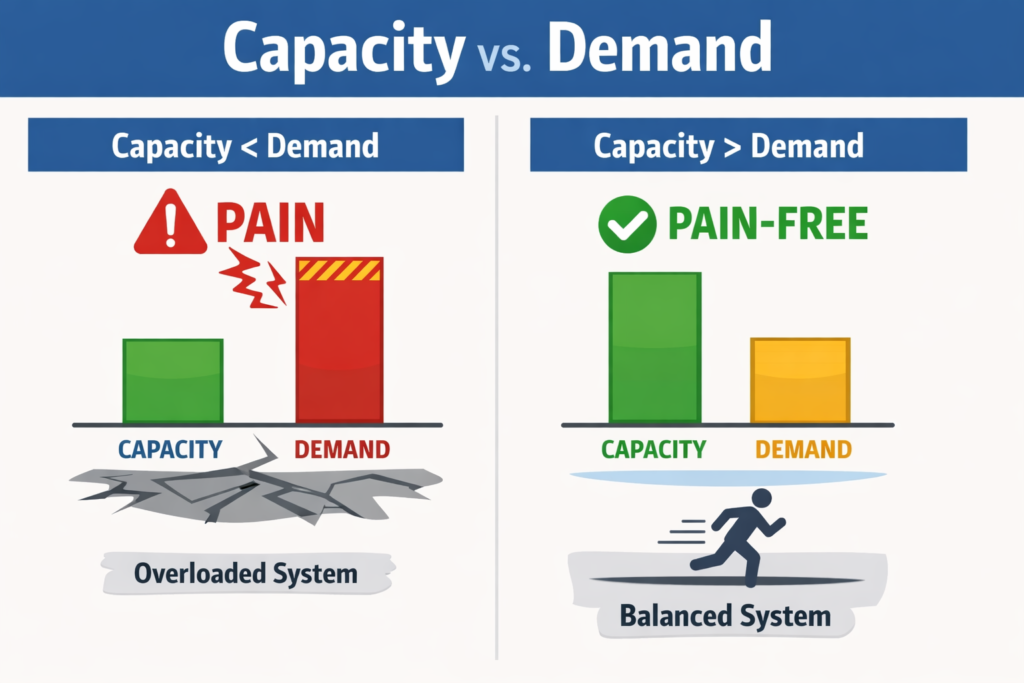
Most pain shows up when there is a mismatch between what your body can handle and what you’re asking it to do.
We can think about this in two parts:
1. Your Capacity (What Your Body Can Handle)
Your capacity is made up of:
- Strength & power: how much force your muscles can produce
- Endurance: how long your body can tolerate activity
- Coordination: how well your muscles work together
- Skill & movement quality: how efficiently you move
These are your body’s “buffer” against stress.
2. The Demand or Stimulus (What You Ask of Your Body)
The demand placed on your body comes from:
- Load (how heavy something is)
- Volume (how much you do)
- Frequency (how often you do it)
- Speed (how fast or explosive the movement is)
Daily life, workouts, sports, yard work, long workdays, and even sitting all place demands on your body.
When Capacity Is Less Than Demand → Pain
When demand exceeds capacity, your nervous system may produce pain as a warning signal, even if there is no major injury.
Your body doesn’t have enough strength, endurance, or control to meet the demand being placed on it — so pain shows up.
This is why pain often appears when:
- You suddenly increase activity
- You return to exercise after time off
- You do repetitive tasks for long periods
- Stress, poor sleep, or fatigue reduce your capacity
When Capacity Matches/Exceeds Demand → Pain-Free Movement
When your body has enough capacity to meet the demand, movement feels smoother, stronger, and far less painful. This is the goal of rehabilitation and physical therapy.
Why Strengthening Matters (and Stretching Alone Often Isn’t Enough)
Many people try to “fix” pain with rest or stretching alone. While those tools can help temporarily, they don’t usually increase capacity.
Pain often improves long-term when we:
- Build strength
- Improve movement patterns
- Increase tolerance to load
- Progress activity gradually and consistently
This doesn’t mean “push through pain at all costs.” It means progressive strengthening — slowly increasing what your body can handle so that everyday demands no longer overload your system.
Stronger muscles and better movement patterns:
- Reduce stress on joints
- Improve efficiency
- Increase confidence in movement
- Make pain less likely to return
The Big Takeaway
Pain does not automatically mean damage. More often, pain is your body saying: “I’m being asked to do more than I’m currently prepared for.” The solution isn’t avoidance, it’s building capacity in a smart, progressive way.
How a Physical Therapist Can Help
A skilled physical therapist can:
- Identify where your capacity is lacking
- Determine which movements or loads are driving your pain
- Teach proper movement patterns
- Design a progressive strengthening plan tailored to you
- Help you return to activity safely and confidently
If you’re dealing with pain and aren’t sure why (or you’ve been told “nothing is wrong” but still hurt), give us a call at (973) 791-8337 so you can start feeling better.
Pain-free movement is not about being fragile, it’s about being prepared.
– Dr. Will Hylton
PT, DPT, OCS, CSCS
Better With Physical Therapy
306 Main Street, Madison, NJ